
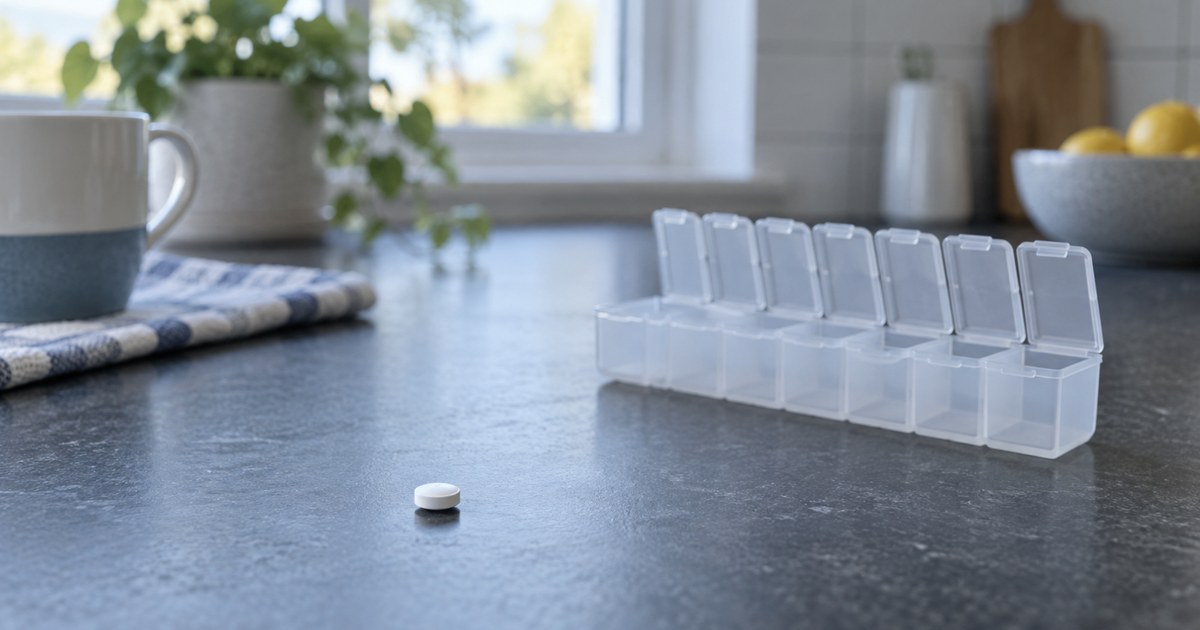
You have found a small white round pill with no markings. It was in a coat pocket, or on the floor by the bed, or at the bottom of a weekly organizer where it does not belong. You have turned it over twice under the kitchen light, and both faces are blank. Every search you have run so far ends in the same place: a forum thread where someone says it cannot be identified, and then stops.
That answer is correct, and this post explains why, because the reason is more useful than the verdict. In the United States, federal rules require nearly every prescription and over-the-counter tablet or capsule to carry a unique imprint code. An unmarked tablet is therefore not a mystery medicine whose code you are failing to find. It is almost always something that sits outside that imprint system, or in rare cases a product that should have been marked and was not, which narrows what it can be to a short list of categories. No app, database or pharmacist can name it from its appearance, but you can still work out what kind of thing it is and what to do with it.
Why a small white round pill with no markings cannot be identified by looks
The rule lives in Title 21 of the Code of Federal Regulations, Part 206. It applies to solid oral dosage form human drug products, which means tablets, capsules and similar products meant to be swallowed, and it covers prescription products, over-the-counter products, biological products and homeopathic products alike. Each one has to be clearly marked with a code imprint that, together with the product’s size, shape and color, allows unique identification of the product and the company that made or distributed it; the one softer case is homeopathic products, which need only carry a code identifying the maker and the fact that the product is homeopathic.
The exemptions are narrow. Drugs used in clinical investigations, medicines compounded by a pharmacist for one named patient, radiopharmaceuticals, products whose size or physical characteristics make imprinting technologically infeasible, and drugs given only in controlled healthcare settings can be exempt. Everything else is expected to carry a code, and a product that should be imprinted but is not may be treated as adulterated and misbranded.
The consequence for the tablet in your hand is direct. Identification tools work by reading the imprint and matching it against current product labeling, the kind held in DailyMed, the National Library of Medicine’s database of labeling submitted to the FDA. Shape and color only narrow that match. Without an imprint there is nothing to look up, because the imprint is the only feature that manufacturers are required to make unique. Many white round tablets look identical to each other, and the law never intended appearance alone to tell them apart, which is exactly why a pill identifier by color and shape can only ever narrow a search, never finish one. If you want the fuller explanation of how those codes are built and read, see what pill imprint codes mean.
The categories an unmarked tablet usually falls into
Because the imprint rule reaches so far, a genuinely blank tablet has usually arrived from one of a handful of places. These are categories, not a guess about your specific tablet, and the honest position is that a photograph cannot tell you which category applies.
- Dietary supplements and vitamins. The FDA regulates dietary supplements under a different set of rules from those covering conventional foods and drug products, and it does not approve them before they are sold. The imprint requirement in Part 206 is a drug rule, so it does not apply to supplements. Plain white tablets of vitamins, minerals and herbal products are common, and they are the most frequent answer to “what is this unmarked pill in the kitchen”.
- Products bought outside the United States. Other countries have their own marking conventions, and some do not require an imprint at all. A tablet that came home in a suitcase or was ordered from an overseas pharmacy may be perfectly ordinary where it was made and still be blank by US standards.
- Compounded medicines. When a pharmacist prepares a medicine for one specific patient on a valid prescription, that preparation is exempt from the imprint requirement. Compounded capsules and tablets are often unmarked, and they are identified by the pharmacy label on the container rather than by anything on the dosage form.
- Some veterinary products. Part 206 covers drug products for human use. Medicines made specifically for animals sit under different rules, and many are unmarked or carry markings that human identifier databases do not hold. If there is a pet in the house, a blank tablet may belong to it.
- A broken half where the marking was on the missing piece. Many tablets carry their code on one face only, and a scored tablet snapped in two can leave one half with the whole imprint and the other half with none. A clean flat edge, or a slightly ragged one, is the clue that you are looking at a fragment.
None of these categories is more likely than the others in general. The context in which the tablet turned up is a far better guide than its appearance. A blank tablet under the vitamin shelf is probably explained by the vitamin shelf. A blank tablet in a pill organizer belonging to someone who takes a compounded medicine is probably explained by that.
Before you decide it is unmarked, check for a faint imprint
A surprising number of “unmarked” tablets are marked. Imprints on white tablets are often debossed, pressed slightly below the surface without any ink, and on a smooth white coating under an overhead light they can be almost invisible. Flash makes this worse by flattening the surface and bouncing off the coating.
Take the tablet to a window or a desk lamp and hold it so the light comes in low from one side, almost skimming across the face. Rotate it slowly. A debossed code catches shadow at that angle and appears, often quite clearly, where a moment earlier there was nothing. Try both faces, because the code can be on either one, and try the edge of a capsule along its body, where printed codes usually sit.
If a marking appears, photograph it in that same low side light against a plain contrasting background, and you are back in the normal identification process, which is covered step by step in how to identify a pill from a picture. If you are choosing a tool for that step, what to look for in a pill identifier by picture app explains what separates a useful one. If both faces are genuinely blank in raking light, you can be confident the tablet has no imprint to find.
The sensible decision path for a blank tablet
If a child or a pet may have swallowed one of these tablets, that comes before everything in this post. Contact Poison Help at 1-800-222-1222 in the United States, which is free, confidential and available around the clock, or emergency services if someone has collapsed, has trouble breathing or cannot be woken. The people who answer can work from a description and from where the tablet was found; they do not need you to identify it first.
For the ordinary case, where the tablet is simply loose and unexplained, the path is short.
- Do not take it, and do not let anyone else take it on a guess. A medicine that cannot be verified by its imprint cannot be verified by anything except the container it came from.
- Bag it and label the bag. Write where and when you found it. A tablet that came from the floor of a particular bedroom, or from a particular slot of an organizer, carries information a pharmacist can use, and that information evaporates once the tablet sits in a drawer for a week.
- Match it to the containers nearby. Compare it to the other tablets in any bottle or blister pack in the same room. A single tablet that matches a supplement bottle on the counter has usually just escaped from it. Only the contents of a labeled container can confirm that, not the tablet itself.
- Ask a pharmacist. Take the bagged tablet and the household’s containers to the pharmacy. The pharmacist is the confirming authority here, the check is free, and they can also tell you whether a compounded or overseas product in the house fits.
- If nothing explains it, dispose of it properly. An unidentified tablet should not go back into a cabinet where it can be mistaken for something else next month. The take-back routes and household-bin steps are laid out in how to safely dispose of old medicines.
When the blank tablet came from the pharmacy
There is one situation that feels like this problem but is not. If the unmarked tablet arrived in a labeled pharmacy bottle, or the whole refill looks different from last month, the bottle is your answer. Compounded medicines are dispensed unmarked as a matter of course, and a refill from a different manufacturer can change color and shape while keeping its code. The label carries the medicine name, strength and pharmacy phone number, and a call to that number resolves it in a minute. The refill case is explained in why your refill looks completely different from last month’s.
The short version
A small white round pill with no markings is not an identification failure, it is a category clue. Federal imprint rules mean the tablets that reach US patients as approved medicines carry a code, so a blank one is most often a supplement, a product from outside the country, a compounded preparation, a veterinary product or the wrong half of a broken tablet. Check for a faint debossed imprint in low side light first, because that changes everything. If the faces are truly blank, bag it, note where it was found, match it against the containers in the house, and let a pharmacist confirm. A tablet nobody can vouch for should be disposed of, not kept.