Most people who look this up are holding one loose tablet and a small, specific worry. A pill at the bottom of a bag. Two medicines that ended up in the same bottle. Something found in a room, or in a pocket, that needs an answer before it needs a conversation. The good news is that a single tablet carries more identifying information than it looks like it does.
The three marks that identify a pill
Every reliable identification, whether done by a pharmacist, a reference database, or an app, rests on the same three features.
- The imprint code. The letters and numbers pressed or printed into the tablet. In the United States this is required on most prescription and over the counter solid medicines, and it is the single most identifying feature a pill has. Two medicines can share a shape and a colour. They should not share an imprint.
- The shape. Round, oval, capsule, oblong, diamond, triangle, and so on. Shape narrows a long list quickly, and it is the feature people describe most reliably from memory. On its own it identifies nothing.
- The colour. Often the first thing anyone notices, and the least dependable of the three. Lighting, wear, and coating changes all shift how a pill reads on camera, and generics of the same medicine are frequently made in different colours by different manufacturers.
The order matters. Imprint first, then shape, then colour. Searching by colour alone returns hundreds of possibilities, which is why "small white round pill" is one of the most common and least answerable questions in the whole category.
How photo identification actually works
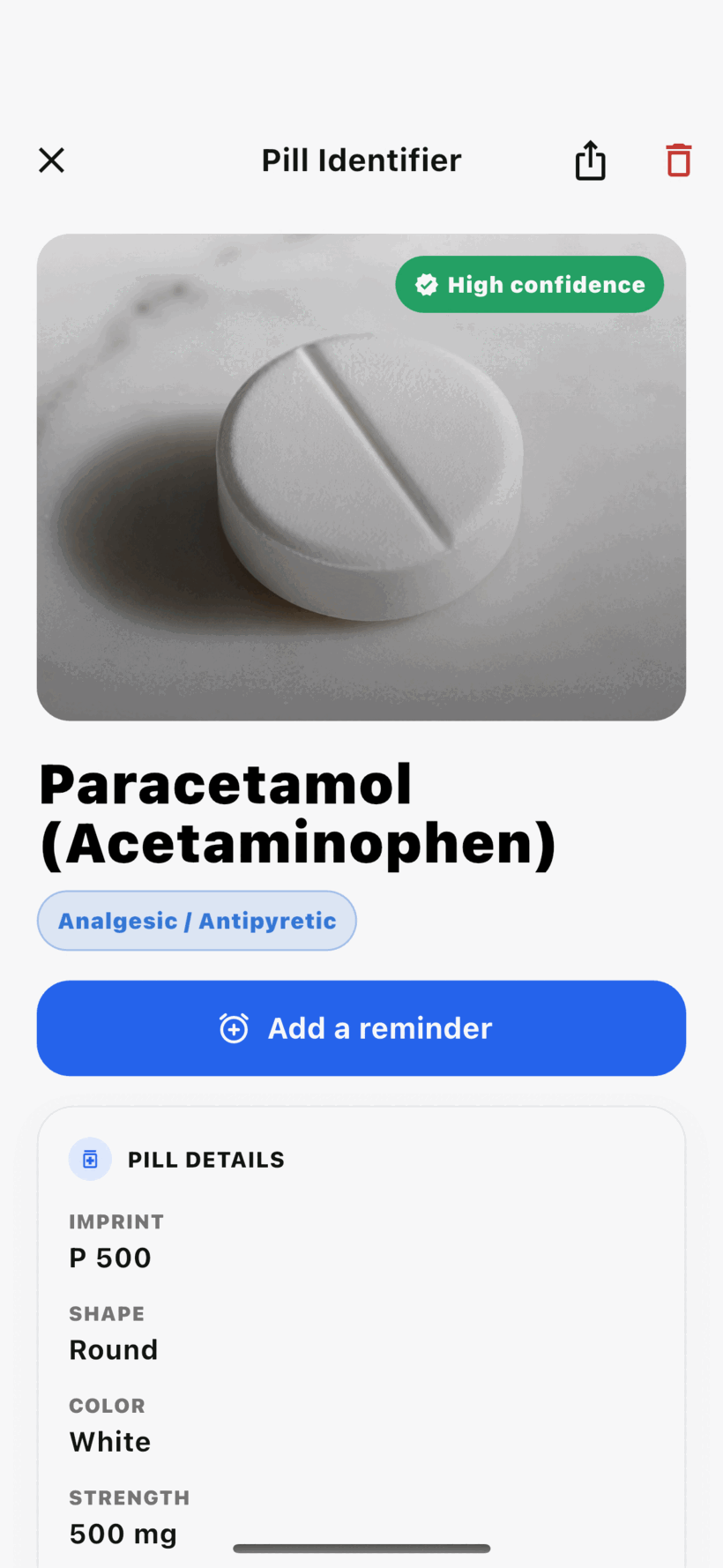
A photo based identifier does in one step what you would otherwise do in three. It isolates the tablet from the background, reads the imprint characters, and classifies the shape and colour. It then matches that combination against published medicine labelling and returns the candidates that fit, with an indication of how sure the read was.
That last part is the part worth caring about. An identification with a clearly legible imprint is a very different claim from a best guess at a worn tablet, and a tool that presents both with equal confidence is not being straight with you. RxVue shows a confidence level alongside every result for exactly that reason.
Taking a photo that can actually be read
Identification quality is mostly photo quality. These five things account for nearly every failed read.
- Put the pill on a plain, flat surface with some contrast. A white tablet on a white counter is the hardest possible case.
- Use even, indirect light. Direct flash blows out the imprint, which is exactly the detail that matters most.
- Fill the frame with the pill and hold steady until it is sharp. A crisp imprint beats a bright photo every time.
- If the imprint runs across a score line or wraps onto the other face, photograph both sides.
- Wipe off dust or powder residue first. It reads as part of the imprint.
When a picture is not enough
A photo stops being sufficient in four situations, and it is worth knowing them before you rely on an answer.
- No imprint. Supplements, vitamins, and medicines made outside the United States frequently carry no marking at all.
- A worn or partial imprint. Tablets carried loose rub smooth. A partial code can match several different medicines.
- A split or crushed tablet. Half an imprint is often genuinely ambiguous, and no tool should pretend otherwise.
- Anything you plan to swallow. An identification tells you what a tablet appears to be. It cannot tell you that it is safe for you, at that strength, alongside everything else you take.
In all four cases the next step is the same and it is free: a pharmacist will identify a tablet over the counter, usually in a couple of minutes, and they can check it against what you are actually prescribed.
Common questions
Can you really identify a pill from just a photo?
Often, yes, when the imprint is legible. The imprint code, shape and colour together are what pharmacists and drug reference databases use, and a clear photo captures all three. What a photo cannot do is confirm what is actually inside a tablet. If the imprint is worn, partial, or absent, a photo narrows the possibilities rather than settling them.
What if the pill has no imprint at all?
Unmarked tablets and capsules are usually supplements, vitamins, or medicines made outside the United States, none of which carry a required imprint. They can also be repackaged or counterfeit. Without an imprint, a photo cannot give a trustworthy identification, and a pharmacist is the right next step.
Is RxVue accurate?
RxVue reads the imprint, shape and colour from your photo and checks them against public medicine labelling, then tells you how confident that read is rather than hiding the uncertainty. Treat it as a fast first answer. A pharmacist can confirm an identification for free, in person, in a couple of minutes, and that is the right way to settle anything you plan to act on.
I found a pill that is not mine. What should I do?
Identify it before you decide anything, because the answer is usually far more ordinary than the worry. Do not taste or split it to investigate. If a child or pet may have swallowed one, contact your local poison control centre or emergency services immediately rather than looking it up first.