Amber bottles accumulate. Each one is small enough to ignore, and after a year of refills there is a drawer of them, some empty, some with a tablet or two rattling in the bottom, all with a label carrying your name. Working out what to do with empty pill bottles is not complicated, but the order matters, and the two steps most guides skip are the ones that prevent problems later.
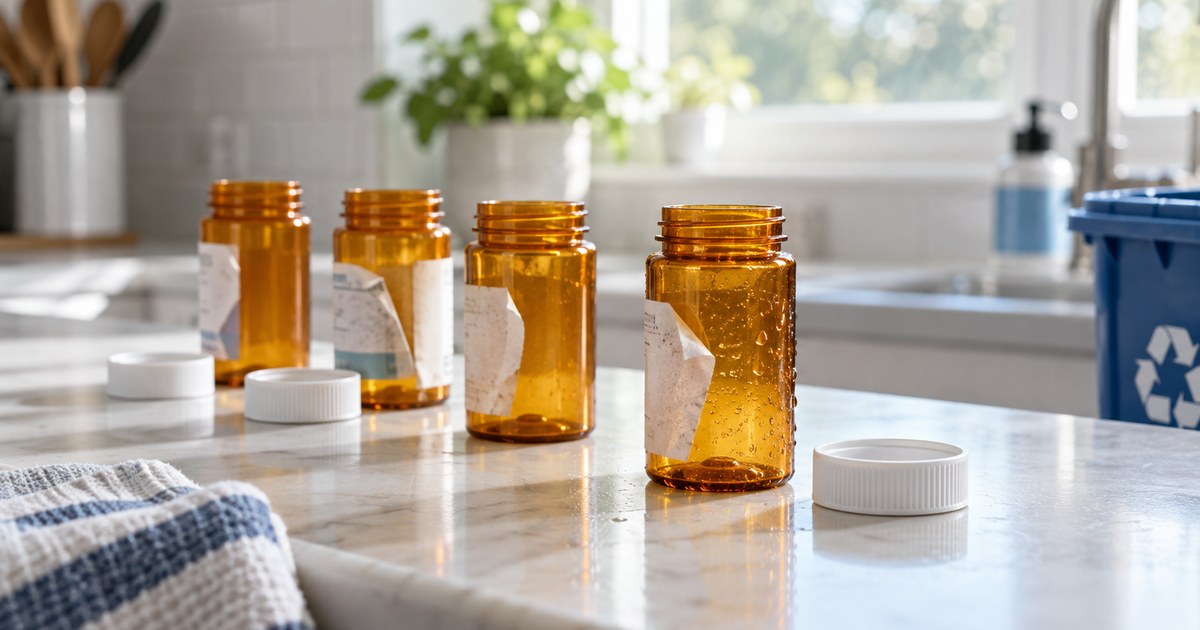
Empty the bottle completely, sending any leftover tablets to a drug take-back rather than the trash or the recycling. Remove or black out the label, which carries your name and prescription details. Then check whether your local recycling program accepts small plastic bottles, and if you keep one for reuse, never put a different medicine in it.
What to do with empty pill bottles that are not quite empty
The most common mistake is treating a bottle with two tablets left as an empty bottle. It is not. Leftover medicine has its own disposal route, and that route is not the recycling bin and not the kitchen trash with the bottle around it.
The FDA’s guidance for unused medicines is that a take-back option is the preferred route, and where one is not available, most medicines can be mixed with something unappealing such as used coffee grounds or dirt, sealed in a container, and put in the household trash. A small number of specific medicines carry flush instructions, and the FDA maintains that list. The full sequence, including take-back locations and the flush-list exception, is in how to safely dispose of old medicines.
Two situations deserve a pause before the bottle goes anywhere.
- The tablets inside do not match the label. Bottles get reused informally, and a bottle labeled for one medicine sometimes holds another. If the tablets have an imprint, a quick photograph gives a first read on what they actually are, which a pharmacist can confirm, before you decide what to do with them; the mechanics are in how to identify a pill from a picture. If they have no imprint at all, treat them as unidentifiable and send them to take-back.
- The bottle is past its date. An expired medicine still goes to take-back like any other; the date changes nothing about the disposal route. What the date does and does not mean is covered in what happens if you take expired medication.
Take the label off, and why it matters twice
The pharmacy label carries more than most people register: your full name, often your address or date of birth, the prescription number, the prescriber, the pharmacy, and the medicine and strength. The FDA’s own disposal guidance tells you to scratch out all your personal information on empty medicine packaging to protect your identity and privacy before throwing it away, and the same applies before recycling.
Labels come off more easily than they look. Warm water and a few minutes of soaking loosen most of them; the residue can be rubbed off or covered. If the label will not shift, a permanent marker over the printed fields, or a strip cut from the label with scissors, does the job. The point is that nobody handling that bottle downstream, at a recycling facility or in a bin, can read a name and a medicine from it.
There is a second reason to remove the label, and it has nothing to do with privacy. A bottle that still says one medicine and holds another is how tablets end up mixed and unidentifiable. Someone tidies, sees a labeled bottle, tips a few loose tablets into it because it is handy, and six months later a caregiver or a family member reads the label and trusts it. If a bottle is going to live on in the house, its old label has to go so that it cannot lie.
Recycling: the honest answer is “check locally”
Prescription bottles are usually a common plastic, and many carry a resin identification code, the small number inside a triangle on the base. The EPA’s guidance on common recyclables explains that these symbols identify the type of plastic used to make a container, that some types of plastic are not accepted in community recycling programs, and that you should check with your local recycling program to find out which types they accept. The EPA also notes that containers should be rinsed clean before recycling, and that caps and labels can typically be left on plastic bottles where the program accepts them, though with a pharmacy label the privacy step above still comes first.
What makes pill bottles awkward is not usually the plastic type. It is the size. Small, lightweight items are harder for the sorting equipment at a recycling facility to handle, and for that reason some curbside programs decline them even when they accept the same plastic in larger bottles. Other programs take them without fuss. There is no national rule; the local program decides, and the fastest way to find out is your municipality’s recycling page or a phone call.
A practical sequence:
- Empty the bottle and deal with any contents as above.
- Remove or black out the label.
- Find the resin code on the base and check it against what your local program accepts.
- Rinse the bottle, dry it, and recycle it with the cap according to your program’s instructions, or put it in the trash if the program does not take it.
Some pharmacies and community programs collect empty prescription bottles separately for recycling or reuse. Availability varies a great deal by area, so ask at the pharmacy counter on your next visit rather than assuming either way.
Reusing a bottle without creating a mix-up
Amber bottles are genuinely useful. They are small, they seal, they are opaque, and they are free. The question is only what goes in them.
For non-medicine items there is no problem at all: screws, beads, seeds, earplugs, spare buttons, a travel portion of a spice. Wash the bottle, remove the label, and it is a good small container. Child-resistant caps are a minor bonus for anything small enough to be a choking hazard.
For medicines the rule is stricter, and it is the rule that keeps tablets identifiable.
- One bottle, one medicine, one clear new label. If you decant a medicine into a spare bottle for travel or a smaller size, write the medicine name, strength and the date on a fresh label, and keep the original pharmacy container so the full information is still in the house.
- Never combine several medicines in one bottle. This is the single most common way a household ends up with a handful of loose tablets nobody can name. Even if you can tell them apart today, a caregiver, a partner or your future self may not, and a tablet with no container to check against has to be identified from its imprint alone.
- Do not reuse a bottle whose old label is still on it. A bottle that says one thing and holds another is worse than an unlabeled bottle, because it invites trust it does not deserve.
If you are already in the drawer sorting bottles, it is a good moment to check that every medicine you still take is in its original container with a legible label, and to photograph anything loose so it can be identified rather than guessed at. If the sorting turns into a full clear-out, organizing the medicine cabinet so it stays that way starts with the right room and original containers. A pharmacist can confirm any identification for free, which is the sensible end point for a tablet you are not sure about.
Blister packs, boxes and the rest
Not everything comes in an amber bottle. Cardboard boxes recycle like any other paperboard once any label with personal information is removed. Blister packs, the plastic-and-foil strips, are a mixed material that most curbside programs do not accept; check locally, and otherwise they go in the trash once emptied. Foil pouches and inhaler canisters have their own handling, and the packaging usually says what to do.
The short version
An empty pill bottle goes through four steps: empty it properly, strip the label, check local recycling, and if you keep it, put nothing in it that the new label does not say. The first two protect your privacy and the medicines still in use; the last one is what stops a spare bottle turning into a mystery.