Most explanations of generic vs brand name drugs fit on a sticker: same active ingredient, lower price. That is true, and it leaves out everything a person actually holding two different-looking bottles wants to know. What exactly is required to be the same? What is allowed to differ, and why does the look so often have to? How does anyone decide that two products are interchangeable? And how do you read your own label to see which one you were given?
The core of it is this. The FDA requires a generic medicine to have the same active ingredient as the brand-name product, in the same strength, the same dosage form and the same route of administration, to be manufactured to the same quality standards, to carry the same labeling with certain exceptions, and to be bioequivalent, meaning it delivers the same amount of active ingredient at the same rate and to the same extent. What the FDA does not require is identical inactive ingredients or an identical appearance. The generic can look different, and in practice usually does. The medicine is the same; the presentation belongs to the manufacturer.
Generic vs brand name drugs: what the FDA requires a generic to match
A generic is approved by showing that it is the same as an already-approved brand-name product in the ways that matter to how it works. The FDA’s list is specific:
- The same active ingredient. The substance that does the work is the same chemical.
- The same strength. The amount of active ingredient per tablet, capsule or dose.
- The same dosage form and route. A tablet copies a tablet; something taken by mouth copies something taken by mouth.
- The same quality standards. The generic is manufactured under the same strict standards the brand-name product is held to.
- The same labeling, with certain exceptions. The information and instructions match the brand’s, apart from limited differences such as a protected use the generic is not approved for.
- Bioequivalence. The generic has to demonstrate that it delivers the same amount of active ingredient to the patient at the same rate and to the same extent as the brand.
That last point is the one people mean when they ask whether a generic really is the same. It is a measured requirement, established by study, not a declaration. The FDA also notes that in a minority of patients small allowable differences between products made by different companies, such as in certain inactive ingredients, can be noticeable, and its advice in that case is to talk to a healthcare provider or pharmacist. That question, and any question about switching between versions, belongs to them and is outside what this post covers.
What is allowed to differ, and why the look so often must
Inactive ingredients are the fillers, binders, coatings and colorings that turn a measured amount of active ingredient into something that can be manufactured, swallowed and kept on a shelf. A generic manufacturer chooses its own, within the FDA’s rules, and the FDA generally allows minor differences in appearance between generic and brand products, such as in color.
The appearance often has to differ, not merely may. The FDA’s own explanation is that trademark law in the United States does not allow a generic to look exactly like the brand product already on the market, so a generic manufacturer cannot simply copy the brand tablet’s color, shape and markings. Each company gives its version a distinct appearance, and each company’s version carries its own imprint code identifying that company’s product. The practical result is that one medicine at one strength can exist on the market in many different-looking forms, all of them the same medicine.
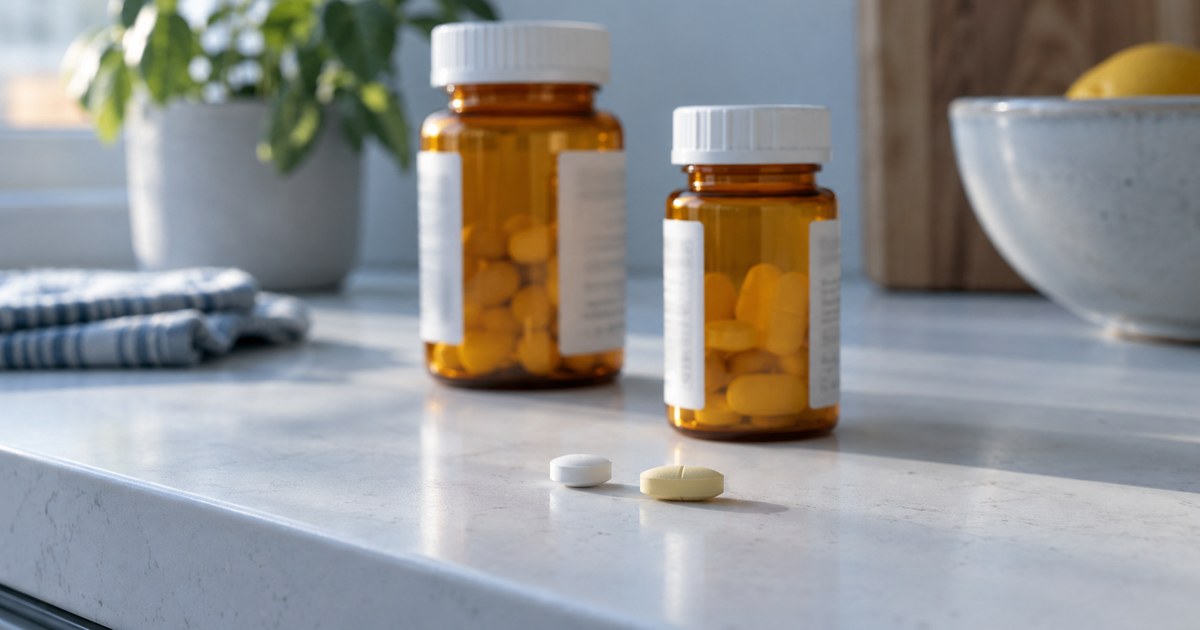
This is where the confusion in the cabinet comes from. A refill dispensed from a different manufacturer than last month is the same medicine at the same strength, and it can be a different color and shape with a different code. If that is the situation you are in right now, the moment-by-moment check is covered in why your refill looks completely different from last month’s. This post stays with the explanation behind it.
The Orange Book, in one paragraph
The decision that a generic is interchangeable with its brand is recorded in an FDA publication called Approved Drug Products with Therapeutic Equivalence Evaluations, known as the Orange Book. It identifies drug products approved on the basis of safety and effectiveness, together with patent and exclusivity information, and it assigns therapeutic equivalence codes to products. In plain terms, a code beginning with A means the FDA considers the product therapeutically equivalent to other pharmaceutically equivalent products, and for tablets and capsules the code most people encounter is AB, which indicates that equivalence has been supported by bioequivalence evidence. A code beginning with B means the FDA does not currently consider the product therapeutically equivalent, usually because a bioequivalence question is unresolved or the data are insufficient. The FDA can also change a product’s code in the Orange Book if a concern arises, which is one of the ways the system stays current.
For a reader, the Orange Book is useful in two ways. It is searchable by active ingredient and product name, so you can look up whether a generic version of a medicine exists and how it is rated. And it is the reason your pharmacist can substitute a generic for a brand at all: state substitution practice generally leans on these ratings, and an A-rated generic is the one a pharmacy dispenses in place of the brand. If you have a specific question about whether a particular product was substituted, the pharmacist can answer it from the dispensing record.
How the label tells you which one you got
You do not need the Orange Book to know what is in your own bottle. The dispensing label carries the answer, in three places. For medicines you buy without a prescription, the Drug Facts label does the same job, as what OTC means explains.
The manufacturer or labeler name. Pharmacy labels usually print the name of the company whose product was dispensed, sometimes abbreviated. If the company named is not the brand’s maker, you have a generic. If the name changes between refills, you have a different manufacturer’s generic, which is the usual explanation for a different-looking tablet.
The “generic for” line. Many pharmacies print the generic name and then the brand it substitutes for, in wording such as “generic for” or “substituted for”. The presence of that line is a direct statement that a substitution was made. Its absence does not mean the reverse, since not every pharmacy prints it, but where it is present it settles the question.
The imprint on the tablet itself. Every solid oral medicine sold in the United States is required to carry a code that identifies the specific product and the specific labeler. The code on a generic points to the generic’s manufacturer, not to the brand, so reading it tells you not only which medicine you have but whose version it is. A photograph of the tablet resolves that in seconds and is easier than squinting at a worn code; the method is in how to identify a pill from a picture, and the meaning of the codes themselves is in what pill imprint codes mean. The package carries a separate identifier of its own, explained in what an NDC number is. A pharmacist can confirm the match against the dispensing record, free, in a minute.
The cost figure, and where it comes from
The reason generics exist as a category is price, and the figure usually quoted is real but often stated loosely. The FDA’s own account is that generic medicines are typically sold at substantially lower prices than the brand, and that the effect grows with competition: a single generic competitor can lead to price reductions of around 30 percent, while five competing generics are associated with price drops of nearly 85 percent. The FDA also reports that roughly nine out of ten prescriptions filled in the United States are for generics. Those numbers explain why substitution is the default in most pharmacies, and why a refill from a different manufacturer is such an ordinary event: several companies are competing to supply the same product, and which one’s version reaches a particular shelf in a particular month is a matter of supply.
What this post deliberately does not compare
It would be easy to end with a verdict on whether generics work as well, or feel the same, or suit a particular person. Those are questions about an individual and a specific medicine, and the FDA’s guidance routes them to the prescriber or the pharmacist, who can see the whole record. What can be said generally is what is above: the approved generic is required to match the brand in active ingredient, strength, form, route, quality and bioequivalence, and it is allowed to differ in inactive ingredients and appearance. Any decision to switch, or not to switch, is made with the people who prescribed and dispensed it.
The short version
Generic vs brand name drugs comes down to a distinction between the medicine and its presentation. The FDA holds the generic to the same active ingredient, strength, dosage form, route, quality standards and bioequivalence as the brand, and records the equivalence decision in the Orange Book, where an AB rating is the code most tablets and capsules carry. The look is allowed to differ and, because of trademark law, usually has to, which is why the same medicine appears in many colors and shapes with many imprint codes across manufacturers. Your dispensing label tells you which version you received through the labeler name, the “generic for” wording, and the imprint on the tablet, and a pharmacist can confirm it from the record in a minute.
Sources
- Generic Drug Facts, U.S. Food and Drug Administration
- Generic Drugs: Questions and Answers, U.S. Food and Drug Administration
- Questions and Answers on Generic Drugs, U.S. Food and Drug Administration
- Generic Drugs, U.S. Food and Drug Administration
- Approved Drug Products with Therapeutic Equivalence Evaluations (Orange Book), U.S. Food and Drug Administration