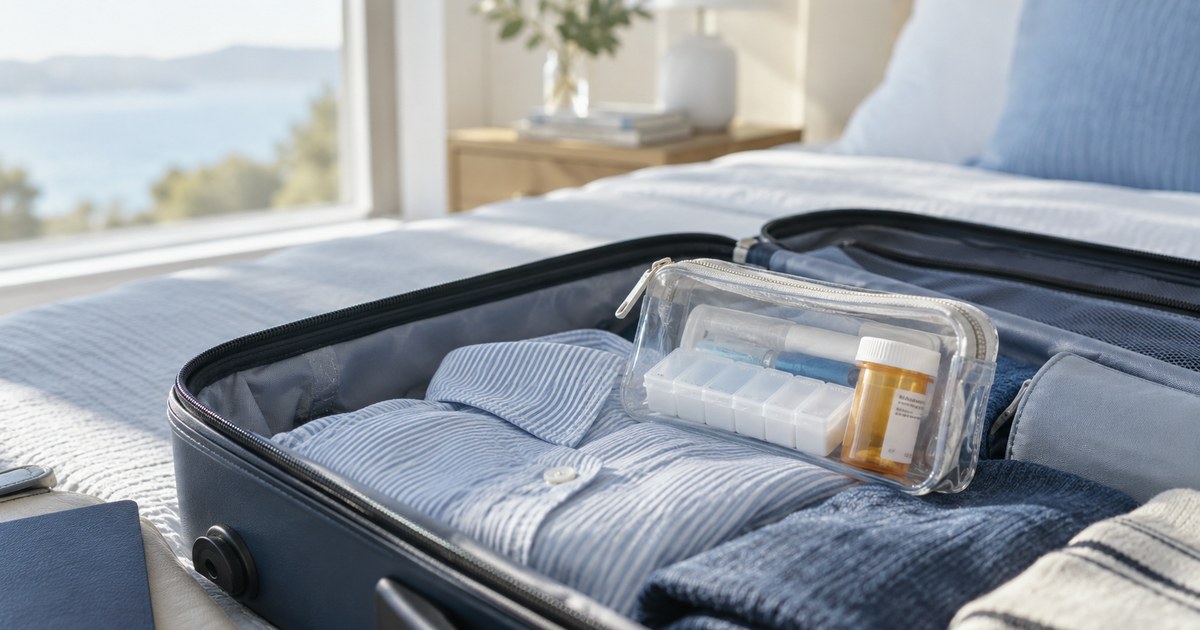
The night before a flight, the medicine question usually arrives in one of two forms. Either a week’s worth of tablets is already sorted into a pill organizer and you are wondering whether that is allowed through security, or everything is still in its pharmacy bottles and you are wondering whether you need to bring the paperwork. The TSA medication rules are shorter and more relaxed than most people expect, and the part that actually causes trouble on a trip is not the checkpoint at all.
TSA allows medication in pill or solid form in unlimited amounts, in carry-on and checked bags, as long as it is screened. TSA does not require pills to be in their original prescription bottles. Liquid medication over 3.4 ounces (100 ml) is allowed in carry-on bags in reasonable quantities if you tell the officer at the start of screening.
The TSA medication rules, in TSA’s own words
TSA’s own travel-tips page answers the pill-case question directly, so it is worth reading the rules in TSA’s words rather than a travel blog’s paraphrase.
- Solid medication has no quantity limit. TSA states that you can bring your medication in pill or solid form in unlimited amounts, provided it is screened. A month’s supply, a two-week supply and a single blister strip are all treated the same way.
- Original bottles are not required by TSA. TSA’s wording is that it does not require passengers to pack medicine in prescription bottles. A weekly organizer, a small pill case or a zip bag is acceptable at the checkpoint as far as TSA is concerned.
- Carry-on or checked, your choice, with a strong recommendation. You may travel with medication in both carry-on and checked baggage, and TSA strongly recommends keeping it in your carry-on in case you need immediate access; a delayed bag or a missed connection is the practical reason why.
- Liquids are the exception to the usual limit. Medication in liquid form over 3.4 ounces is allowed in carry-on bags in reasonable quantities for a flight. The condition is that you tell the officer you have medically necessary liquids at the start of the screening process, so it can be screened separately from the standard liquids bag.
One line on TSA’s page deserves more attention than it usually gets. TSA notes that certain state laws are in place regarding the labeling of prescription medicine, and passengers are expected to comply with them. So “TSA does not require the bottle” is not the same as “no one requires the bottle”. If you are traveling somewhere with its own rules on labeled prescriptions, the pharmacy container is the simplest way to satisfy them.
Leaving the country changes the rules
Everything above is about US airport screening. The moment a destination is outside the United States, the relevant authority is the country you are entering, and its rules can be stricter than anything TSA applies.
The CDC’s Pack Smart guidance for travelers puts it plainly: some countries have restrictions on what medications you can bring with you, so check with the US embassy for the country you are traveling to. The CDC’s packing list for prescriptions also says to carry them preferably in their original bottle, and to bring copies of your prescriptions. That combination, original container plus a copy of the prescription, is the safest default for any international trip, because it answers the two questions a border officer is most likely to ask: what is this, and is it yours.
For the return leg, US Customs and Border Protection publishes its own guidance on traveling with medication. The general shape of it is the same: keep medicine in its original, labeled container, carry only what you need for the trip, and be ready to declare it. Read CBP’s page before you leave rather than at the airport on the way home, since it also covers what happens when a medicine bought abroad is not one that is approved for sale in the United States.
The organizer problem nobody mentions
Here is the practical gap in most travel advice. A pill organizer is legal to fly with, convenient, and light. It is also the single most common reason a tablet becomes unidentifiable away from home.
At home, a loose tablet on the bathroom floor can be matched against the bottles on the shelf. In a hotel room there are no bottles. If the organizer’s lid pops open in a bag, if two compartments get mixed, or if a tablet turns up on the nightstand and you are not sure which one it is, there is nothing to check it against. The same thing happens when a refill dispensed just before the trip looks different from the last one; at home you would read the label, but on the road the label is a thousand miles away.
The fix costs about two minutes before you pack.
- Photograph each medicine before it goes into the organizer. One clear photo of the tablet, imprint side up, next to its pharmacy label. If a stray tablet turns up later, you have a reference set to match against, and a photo identifier can read the imprint from a fresh shot in seconds. The technique for a clean shot is covered in how to identify a pill from a picture.
- Keep the labels even if you leave the bottles. Peel the pharmacy label off, or photograph it, or pack the empty bottle flat. The label carries the medicine name, strength and the pharmacy’s number, which is exactly the information you will want if anything needs checking.
- Save the pharmacy’s phone number in your contacts. A pharmacist who dispensed the medicine can confirm what it looks like and what was dispensed, and that is the confirming step for any identification, on the road or at home.
If a refill before the trip already looks different from last month’s, sort that out before you pack rather than after. The reasons a refill changes appearance, and how to check it, are in why your refill looks completely different from last month’s.
Packing for someone else
If you are traveling with an elderly parent, or packing their medicines for a trip you are not on, the organizer problem is sharper, because the person taking the tablets may not recognize a change. The same photo-and-label habit works, and it is worth writing a one-page list of what is in each compartment, with the medicine name exactly as it appears on the label. A fuller version of that setup, including who fills the box and when to call the pharmacist, is in medication management for elderly parents.
Two things to keep out of that list: any change to when or how much is taken. Time zones, missed doses and schedule changes are questions for the prescriber or the pharmacist before the trip, not something to work out from a blog post or an app in a departure lounge.
A short pre-flight checklist
- Solid medication: any amount, any container that TSA can screen, carry-on preferred.
- Liquid medication over 3.4 ounces: carry-on, reasonable quantity, declared at the start of screening.
- Domestic trip: check whether your destination state has prescription labeling rules; if in doubt, bring the pharmacy container.
- International trip: check the destination’s rules through the US embassy, carry original containers and copies of prescriptions, and read CBP’s guidance for the return.
- Before packing: photograph each medicine with its label, keep the labels, save the pharmacy’s number.
The short version
TSA medication rules are permissive: pills in any amount, in any container, screened like everything else, with liquids over 3.4 ounces declared rather than banned. The real risk on a trip is a tablet with nothing to check it against, and a photo of each medicine taken before you leave removes that risk almost entirely.